
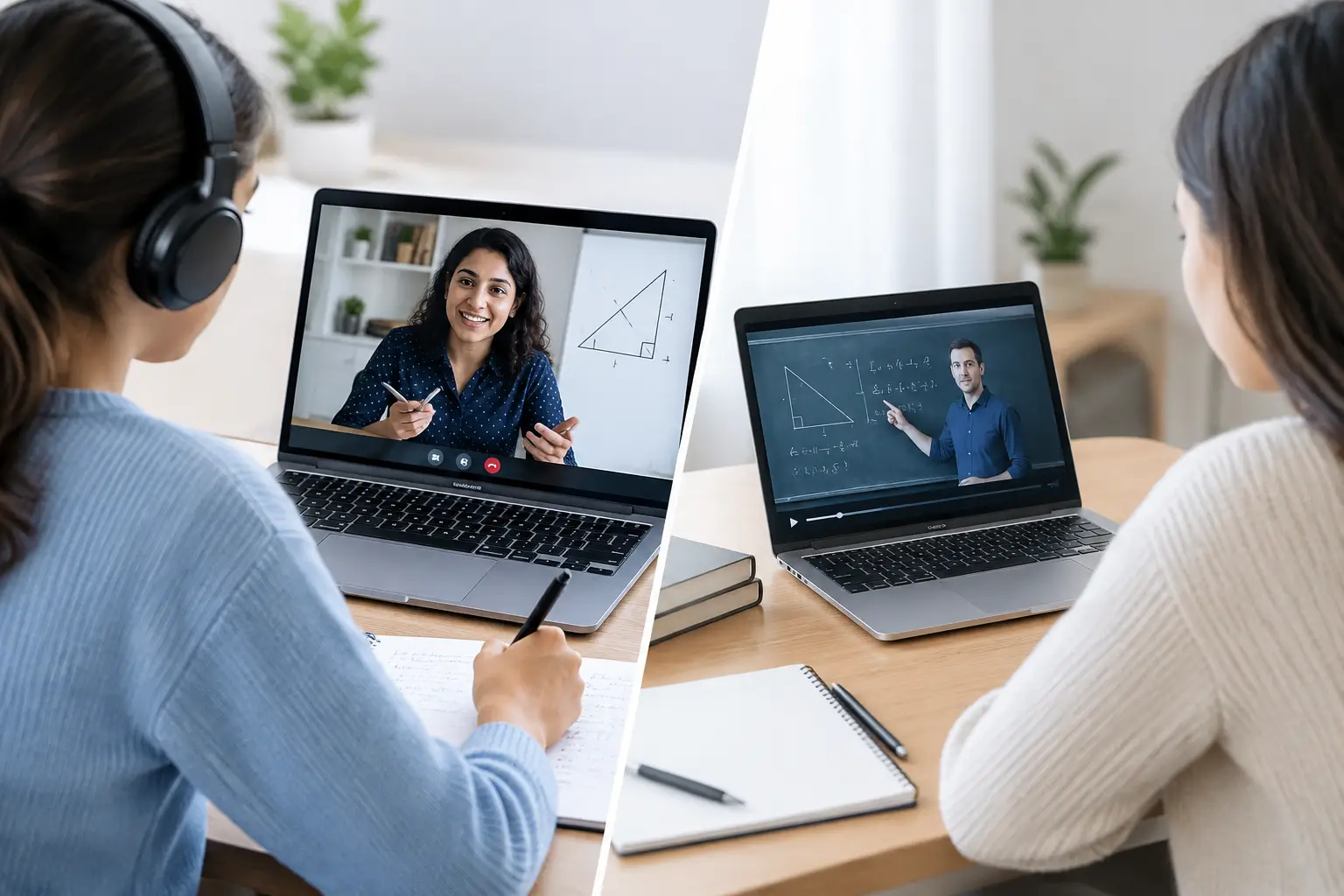
A student can watch a clear video on solving quadratic equations, feel confident while following each step, and still freeze when the next homework problem changes one number. That gap is at the center of live tutoring vs recorded lessons. Both can support math learning, but they solve different problems. The better choice depends on whether a student needs information, practice, feedback, accountability, or help rebuilding an earlier skill.
For families, the question is rarely whether videos are useful. They often are. The more useful question is what happens after the video ends. Can the student apply the method independently? Can they explain why it works? Does someone notice when they are using the wrong rule, skipping a step, or relying on a memorized procedure that will fail on the test?
Live Tutoring vs Recorded Lessons: The Core Difference
Recorded lessons deliver instruction in one direction. A teacher or presenter explains a concept, usually with examples, and the student can pause, rewind, or replay the material. This format is efficient when the lesson closely matches the student’s course and the student already has enough foundation to practice independently.
Live tutoring is responsive instruction. The tutor can see the student’s written work, ask what they notice, change the explanation when it is not landing, and select problems based on the student’s actual assignments and misunderstandings. In mathematics, that responsiveness matters because a wrong answer rarely tells the whole story. A student may have made a small arithmetic error, confused two similar formulas, or missed a prerequisite concept from several years earlier. Each calls for a different next step.
Neither format automatically produces learning. A student can passively watch a recording just as they can sit quietly in a live session without engaging. The difference is that a skilled live tutor can recognize passivity and bring the student back into the work through questions, examples, and guided practice.
When Recorded Lessons Work Well
Recorded lessons are especially useful for review. A student preparing for an Algebra 2 quiz may benefit from replaying a five-minute explanation of completing the square. An AP Calculus student may want to revisit a lesson on related rates before attempting a new problem set. The ability to pause at a difficult line and repeat an explanation can reduce pressure and support students who need more processing time.
They are also practical for students who need a quick reminder of a procedure they have already learned. If a student understands how to find the slope between two points but forgets the order of the formula, a short recording can be enough to refresh the skill.
The limitation is alignment. General videos often use different notation, methods, pacing, or problem types than a student’s classroom. That does not make them wrong, but it can create confusion when a teacher expects a specific approach. Recorded instruction also cannot ask the student to show their work or identify the exact line where their reasoning changed direction.
For self-directed learners with strong foundations, recordings can be a valuable part of a study routine. They tend to be less effective when a student says, “I understand it when someone explains it, but I cannot do it myself.” That statement usually points to a need for active practice and immediate feedback, not another explanation of the same kind.
What Live Math Tutoring Adds
Live tutoring turns mistakes into useful information. Instead of simply marking an answer incorrect, the tutor can ask the student to talk through their approach. In a session on systems of equations, for example, a tutor may see that the student knows how to eliminate a variable but changes the sign incorrectly when multiplying an entire equation. The lesson can then focus on that precise habit, with enough guided practice to make the correction stick.
This process is particularly valuable in math because skills build on one another. A student struggling in geometry may actually need support with fractions, negative numbers, or algebraic manipulation. A student having trouble in Calculus may not need a full reteaching of derivatives. They may need to strengthen function notation or learn how to translate a word problem before choosing a derivative rule.
A live tutor can start at the step that stopped making sense rather than treating every struggle as a problem with the current chapter. That protects session time and helps students see math as a connected set of ideas rather than a series of unrelated rules.
Guided thinking matters more than answer delivery
The strongest tutoring does not replace a student’s thinking. It makes that thinking visible. A tutor might ask, “What does this exponent tell us?” or “Which quantity is changing?” before offering a method. The student learns to make decisions, test an approach, and recognize whether an answer is reasonable.
This is why live instruction is often helpful for honors, AP, IB, A-Level, and college courses. Advanced problems may have several plausible starting points. Students need more than a demonstration. They need practice selecting a strategy and explaining their reasoning under conditions similar to homework, quizzes, and exams.
Accountability can change the study pattern
Many students do not struggle because they lack access to explanations. They struggle because their independent work is inconsistent, they avoid the hardest problems, or they do not realize they are practicing a method incorrectly. A scheduled session creates a regular point for reviewing assignments, checking understanding, and setting a specific next step.
For parents, documented session notes and progress updates also provide useful visibility. Rather than hearing only that tutoring “went well,” families can understand what was covered, where the student is improving, and what should be practiced before the next meeting. This is especially helpful when grades are changing slowly, as they often do when foundational gaps need attention first.
Choosing the Right Support for Your Student
Start with the student’s actual obstacle. If they are generally confident, can complete similar problems alone, and need occasional review before a test, recorded lessons may be sufficient. Pair the recordings with a few problems completed without notes. That final step matters: recognition while watching is not the same as retrieval and application.
Live tutoring is often the stronger fit when the student repeatedly gets stuck, has begun avoiding math, receives low scores despite studying, or cannot explain why a method applies. It is also useful when the course moves quickly and the student needs support that follows classroom materials rather than a general sequence of online videos.
Consider the goal as well. A student who needs to repair pre-algebra foundations requires a different plan than a student preparing for AP Statistics or a college Calculus II exam. Effective support should be matched to the course, the student’s current level, and the type of mathematical thinking the next assessment requires.
At Think-Nth, this means beginning with the student’s real course materials and current questions, then matching the student with a math-specialist educator who can build a focused learning plan. The live whiteboard is not simply a place to display answers. It is a workspace where students can write, revise, and practice with guidance while their tutor monitors the reasoning behind each step.
A Practical Way to Use Both
For many students, the best answer is not choosing one format exclusively. Recorded lessons can prepare a student for a live session or reinforce what was covered afterward. A student might watch a short review of logarithm rules, attempt assigned problems, and bring the problems that caused difficulty to tutoring. The session can then focus on misconceptions, problem selection, and independent practice rather than repeating material the student already understands.
This approach works only if the roles are clear. Use recordings for exposure and review. Use live instruction for diagnosis, guided practice, feedback, and the harder questions that do not resolve after a replay. When students treat a video as a replacement for working problems, progress often stalls. When they use it as one tool in an organized study plan, it can support meaningful learning.
The right support should leave a student more capable of facing the next problem without help. Look for instruction that does not merely make tonight’s homework easier, but helps the student recognize what to do when tomorrow’s question looks different.